


A gym apparel preorder system lets you collect orders before production, which reduces inventory risk and usually improves profit. For most gyms, it is the cleanest way to run merch because it removes guessing, reduces leftover stock, and creates urgency around each launch.
Instead of ordering inventory upfront and hoping it sells, you open a focused order window, collect what members actually want, and produce exactly that. The result is better margins, less waste, and a more repeatable system.
Preorder vs bulk vs print-on-demand: how they compare
| Model | How it works | Inventory risk | Owner workload | Best for |
|---|---|---|---|---|
| Preorder (Forever Fierce model) | Collect orders first, produce after | None | Low | Recurring gym merch drops |
| Bulk order | Buy inventory upfront, sell after | High | Medium | Gyms with reliable demand history |
| Print-on-demand | Print per order, ship direct | None | High (you manage the store) | Self-managed ecommerce stores |
What Is a Pre-Order System?
The concept is simple: you sell first, then print. Instead of guessing how many medium tees your members might want, you open a short ordering window — typically 5 to 7 days — collect payment upfront from every member who wants something through your merch webstore, then submit those exact quantities to your printer.
Every piece is already paid for before production begins. No leftover inventory. No cash tied up on shelves. No markdowns. No awkward "buy one get one" sales to move dead stock.
Think of it this way — you'd never buy groceries for 200 people without knowing who's coming to dinner. So why would you buy 200 shirts without knowing who wants one?
Why Most Gym Owners Get Burned by Inventory
The old model works like this: you call a local printer, order a fixed run of each size, pay thousands of dollars upfront, and hope your members buy them. Some do. Many don't. You end up with a pile of XL shirts nobody wants and zero smalls because you underestimated demand.
This is exactly where the conversation around preorder vs bulk becomes critical. Bulk ordering feels efficient, but it shifts all the risk onto you. Pre-orders shift that risk off your balance sheet and onto real demand.
Here's what that actually costs you. Let's say you order 100 shirts at $15 each. That's $1,500 out of pocket before you sell a single one. If you move 70 of them at $30, you've made $2,100 in revenue on $1,500 invested — a $600 profit. Not bad, except you still have 30 shirts sitting in a box. At $15 each, that's $450 of your profit evaporating in dead stock. This is exactly why more gyms are shifting to selling merch without inventory. Your actual profit? $150. For all that effort.
Now run that same order through a pre-order system. You sell 70 shirts at $30 during a 7-day window. You collect $2,100 upfront. You order exactly 70 shirts at $15 each — $1,050 in production cost. Your profit is $1,050. No dead stock. No guessing. No boxes under the front desk. This is the power of a true zero-inventory model.
Same 70 customers. Same design. Seven times the profit.
How to Run a Pre-Order in Your Gym
The mechanics are straightforward. First, finalize your design. One hero design across two to four garment options — a unisex tee, a women's cut, and maybe a hoodie or longsleeve depending on the season. Keep it tight. Research shows that too many options leads to choice paralysis and fewer purchases.
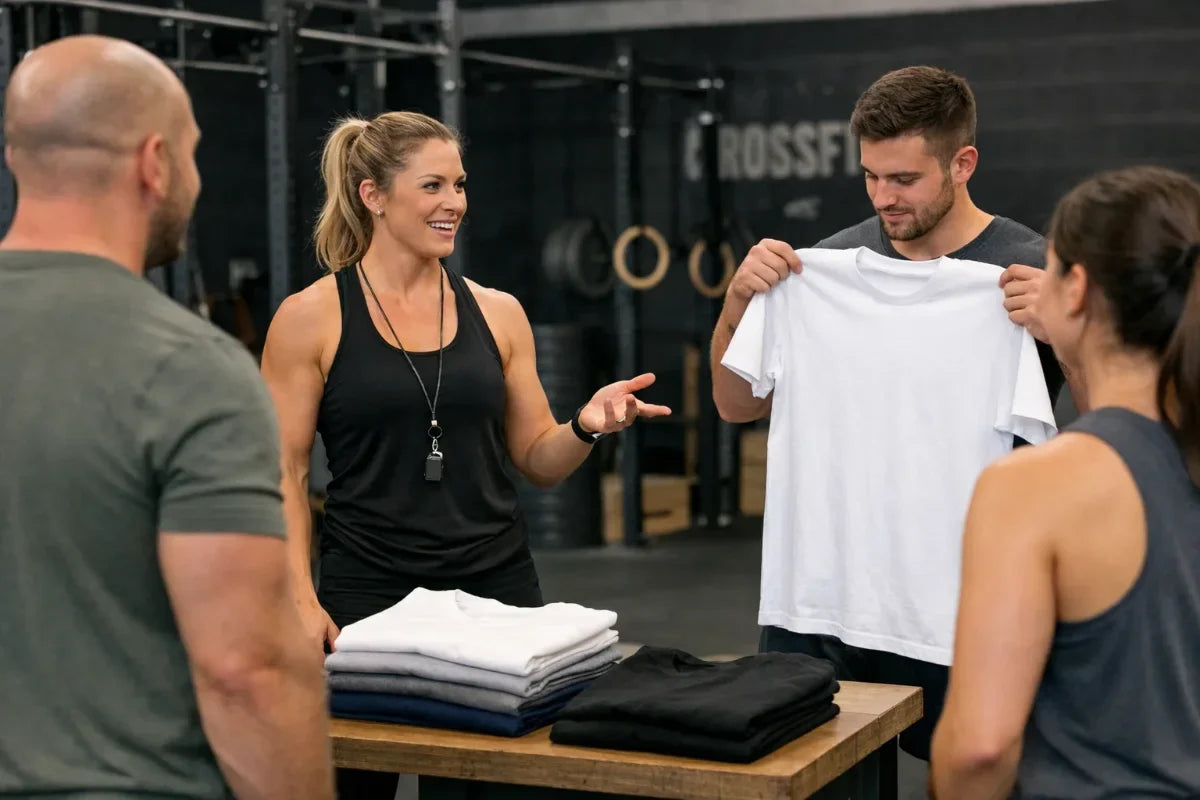
Second, get sizing samples to your front desk. This is non-negotiable. Members who can touch and try on a sample are significantly more likely to buy. Samples take the guesswork out of online sizing charts and give your members the confidence to pull the trigger.
Third, open your order window. Seven days is more than enough. Anything longer gives people permission to procrastinate, and procrastinators don't buy. Set a hard deadline and stick to it.
Fourth, market it like you mean it. Coaches announce it before and after every class. You send three emails over the week — launch, mid-week reminder, last-chance. You post daily on social. You put QR code signage at the front desk, the water fountain, and the bathroom mirror. Inside your internal playbook, this entire system — from design to delivery — should be documented as our process so it becomes repeatable every quarter.
Fifth, close the window. Export your order counts. Submit to production. Deliver in about two weeks. Clear communication around turnaround times builds trust and eliminates the "when will my hoodie be ready?" questions. When orders arrive bagged and labeled by name, pickup day feels like an event.
The 7-Day Marketing Playbook
Most pre-orders underperform because the gym owner posts once on Instagram and calls it a day. That's not marketing — that's hoping.
Here's what actually works. Day one: announce the drop before and after every class, send your launch email, post the design reveal on social media, and make sure samples are prominently displayed at the front desk. Days two through four: keep the in-class mentions going every single session, post coach fit pics and member try-on shots, send your mid-week reminder email. Days five through seven: turn up the urgency with whiteboard countdown timers, send your final-call email, and don't be shy about multiple reminders on closing day. Open rates actually increase with last-call emails — your members aren't annoyed, they're grateful for the reminder.
The gym owners who follow this playbook consistently hit 20 to 30 percent member participation per order. The ones who post once and hope? They're lucky to break 10 percent.
What Pre-Orders Mean for Your Bottom Line
Let's put real numbers on this. A gym with 150 members running 4 pre-orders per year at 25 percent participation sells roughly 150 items per year. At an average profit of $15 per piece, that's $2,250 in annual profit from apparel alone — with zero dollars invested upfront.
Scale that up with better marketing execution and a fifth or sixth drop, and you're easily looking at $3,500 or more per year. For a solo gym owner, that's meaningful money for a process that takes a few hours per quarter. For a deeper look at setting the right price points, see how to price custom apparel for your gym.
And this is where smart operators evolve beyond one-off drops into a structured annual plan — mapping out seasonal releases, member milestones, and event-based collections so apparel becomes predictable revenue instead of random experimentation.
And that doesn't account for the intangible value. Every member wearing your logo outside the gym is a walking billboard. Every hoodie spotted at the coffee shop is free advertising you didn't pay for — actually, your member paid you for the privilege.
The pre-order system isn't complicated. It's just disciplined. Sell first, print second, and keep every dollar of profit you earn.
Keep Reading
- Seasonal Apparel Strategy for Gyms
- Gym Apparel Seasonal Events Calendar
- How to Market a Gym Apparel Drop
- Best Gym Merch Companies for Gym Owners
Ready to run your first preorder? See how the apparel plan works →
Share:
Yorkville CrossFit Streamlines Merch and Wins Back Time
How to Make Money Selling Gym Merch Without Inventory